Friday, March 29, 2013

High on Wilson

Look up on Wilson. No, not all the way up to the pale quartzite towers on the summit ridge, which always make me think of Minas Morgul, the city of wraiths. No, just halfway up the mountain. There, guarded by a first tier of cliffs that turn back all but the most obsessed, all manner of enticing curtains and daggers drape over a second tier. This past winter (and as I write this it's been officially spring already for more than a week), I had an especially hard time tearing my eyes away the bounty of frozen water up there, like a thirsty astronaut on a cold dry moon. Back home, while outwardly engaged in everyday tasks, I'd fantasize about the steep ice and the even steeper rock. What made the prospect even more enticing was that just about every one of the daggers lay in a giant avalanche gully. Where's the adventure if you can go someplace anytime you feel like it? No, the faraway ice on Wilson had to be saved for a special occasion, and then savoured like a fine Scotch. I feel fortunate to have managed a couple of such tastings in the last month or two.

***

Engel

Last December Juan and I added a mixed start to the rarely formed Hypertension. Actually, truth be told, on this particular occasion the bottom pillar was formed but I lacked the cajones to climb it. At the top of the route I untied and breathlessly slogged up the snow bowl above, to get a closer look at the curtain dangling from the next cliff band. The limestone below the ice was overhanging and featureless, and looked unlikely to go on traditional gear. Yet in a perverse way the thought of putting up a bolted mixed climb halfway up Wilson appealed to me. I filed the prospect away for future reference.

February brought the usual spell of good weather and stable snowpack: in other words, good conditions for Wilson. I was torn between a linkup I'd attempted once before and the ice above Hypertension. In the end, for reasons I can't quite remember anymore, the latter won out. Jerome and I left Calgary early on a Saturday morning, determined to devote the entire weekend to the project. The first order of business was to get up Hypertension with a pack loaded down with drill, bolts, pitons and cams (I still hoped the rock might go at least partly on trad gear). The first pitch of Hypertension was a rude awakening: with the pillar snapped off, getting established on the ice took more power than I could muster without a warmup. Consoling myself that what really mattered today was getting up the route as quickly as possible, I continued up sun-affected ice. The redpoint would have to wait until tomorrow.

By early afternoon we stood below our objective. After a deceptively tricky step of mushroomed ice out came the drill. I knew we didn't have the time, hardware or battery power to correct any route finding mistakes, so I took my time choosing a line. A couple of hours later I was lowering from an anchor tucked immediately below where the ice bonded (or so I hoped) to the water-worn rock. With light fading, we ran down the snow slope below and slid down the rappels on Hypertension.

After a good dinner and an even better night's sleep at the Rampart Creek hostel, we were up and hiking before dawn. With the pressure of a redpoint for added motivation, I gasped my way onto the broken dagger. The rest of Hypertension was a formality, and soon we were hiking up the snow bowl above, following in yesterday's footsteps, already partly erased by wind-blown snow.

Once again I knew we didn't have time to waste, this time to mess around figuring out sequences, and so was determined to send the rock first try. Fortunately the drytooling up here proved easier than down below, and it wasn't long before I was tapping my way up a vibrating freehanger. The top pitch was everything we'd hoped it'd be: long and sustained, with ice that was fragile enough to require our complete attention, but solid enough to yield good screws at regular intervals. From the top of the route we gazed at the next snow bowl and the next rock band, this one decorated with delicate strips of what we could just about convince ourselves was climbable ice. But it would have to wait for another day - or season.

"A long sustained curtain 100 m above [Hypertension] may form in some years and would offer a great challenge." - Joe Josephson, Waterfall Ice, 3rd edition.

Now you see it - Hypertension back in December, with the bottom pillar still intact...

... and now you don't - the mixed start to Hypertension in February, after the pillar fell down. Photo: Jerome Yerly.

Getting established on the ice on the first pitch of Hypertension... Photo: Jerome Yerly. 

... and stepping out between the pillars on the third. Photo: Jerome Yerly.

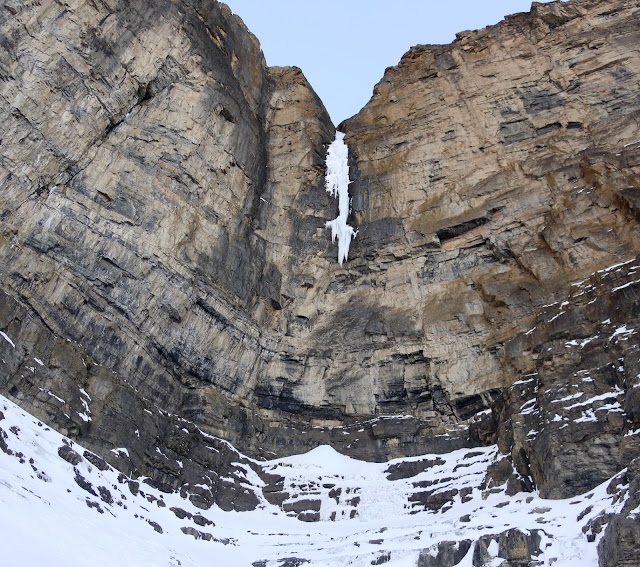
The wall above Hypertension, with Engel right of centre and an unclimbed dagger further right.

Engel: a step of funky ice, a bit of steep drytooling, and then the goods: a long, sustained pitch of chandeliered ice to the lip of yet another avalanche bowl - and yet more dreams of ice on the next tier of cliffs. Photo: Jerome Yerly.

The dagger topping the second pitch resembled an icy missile, freehanging for over ten metres. Photo: Jerome Yerly.

We found what we came for on the third pitch. After all, as fun as the drytooling might have been, the ice above was always the real reason for coming this far. Photo: Jerome Yerly. 

Looking out toward a stormy Divide from high on the climb. Photo: Jerome Yerly.

Engel, 85 m, M8 WI5+
FA: Raphael Slawinski and Jerome Yerly, February 2013

This spectacular line pours down a rockband halfway up the south face of Mt. Wilson. From the top of Hypertension half an hour of walking up a big snow bowl gets you to the base.

Pitch 1 (15 m, WI4+): Climb a short, deceptively steep step to a snow ledge and a 2-bolt belay.
Pitch 2 (20 m, M8): Follow bolts up and left to a big freehanging dagger. Gently peck your way up the left side of the dagger to a 2-bolt belay.
Pitch 3 (50 m, WI5+): Step right from the belay (locate a protection bolt over a small overlap just above the anchor) and climb steep, sustained ice to the top.

Rappel the route from a v-thread at the top and the 2-bolt station at the top of pitch 2.

***

Cythonna

At the start of the ice season another piece of frozen water high up on Wilson caught my eye. A spectacular narrow dagger, it dangled from the rock band above Dancing With Chaos, like a skyscraper with its bottom half removed. In late December Eamonn and I drove up the Parkway with enough technology (i.e. a power drill) to get up the thing; but, once we actually contemplated heading up there, we noticed just how much rock separated the broken-off dagger from the snow below. Eamonn wrangles rocks for a living, and he didn't want to spend the weekend doing more of the same. While my job is less physical, consisting largely of loudly stating the obvious, lately my weekends did in fact involve a fair amount of choss wrangling on a succession of projects. After only a moment's hesitation we dumped the bolting hardware from our packs and went ice climbing instead.

A few weeks later I read on Gery's blog about a new route he and Jon climbed on Wilson. For about a second and a half I felt a twinge of regret that we didn't head up to the dagger above Dancing With Chaos after all, before I realized that I had more on my new-route plate than I could handle. Instead, now I could just go climb the thing without doing the hard work of putting it up.

February was slipping away, and with clear skies and warm temperatures the clock was ticking for south-facing ice routes. In spite of a less than inspiring forecast I talked Ian into heading up to the route. The temperatures and the sun-crusted snow felt positively springlike as we hiked up the drainage below Dancing With Chaos. So did the bleached ice on that route, but fortunately the dagger of Cythonna a few hundred metres higher still glowed a healthy blue.

The drytooling on the first pitch wasn't especially powerful, but the creaky holds and widely spaced bolts held my interest, proving yet again that memorable climbing isn't just about pullin' down. At the top of the pitch, standing on a ledge immediately below the huge ice roof where the dagger had broken off, I realized all the bolting I'd been doing had made me soft. With no solid ice or rock gear to be had, I dubiously eyed Gery's and Jon's abalakov. It was drilled into a hump of unsupported ice and I wasn't keen to commit both Ian and me to it. Mumbling something about how I'd have put in a bolted anchor, I continued up fragile ice to a cave ten metres higher.

As is so often the case with these rock-to-unformed-ice concoctions, the rock on the first pitch may have been harder but the ice on the second was cooler. A chandeliered pillar with breathtaking exposure down to the pock-marked snow below, it provided a fitting finish to the route. From the top anchor we gazed at the pale quartzite towers on the summit ridge far above, and closer at hand at a large avalanche bowl baking in the afternoon sun. It was time to go down.

"[Dancing With Chaos] usually has a huge broken icicle on the rock cliff above." - Joe Josephson, Waterfall Ice, 4th edition.

Ian Welsted starting up a decaying Dancing With Chaos.

Cythonna resembled nothing so much as the top half of a skyscraper, with the unfinished bottom half littering the slope below.

Starting up the first pitch, with the object of our desire far above. Photo: Ian Welsted.

Nearing the end of the first pitch, with the broken dagger looming ominously overhead. Photo: Ian Welsted.

Leaving the belay... Photo: Ian Welsted.

... straight into some crazy and beautiful ice formations. In the end, isn't that the appeal of ice climbing? Not how hard it is, but how unlikely it is? Photo: Ian Welsted.

With less than a month to go until spring equinox, the sun packed a punch.

Friday, March 1, 2013

The God Delusion

Familiarity breeds contempt. I found that out last season, when I got nearly taken out by an avalanche at the base of Man Yoga. After more visits to the Headwall than I could count, I'd forgotten the place still had a few tricks up its sleeve. Ancient Greeks had a word for this kind of thing: hubris (closely followed by nemesis).

Familiarity also breeds familiarity. On my first few times to the Headwall I had eyes only for the obvious lines: Nemesis, Suffer Machine, French Reality... But as I returned time and again, I started noticing the subtle details between the bold strokes: ephemeral, discontinuous drips, like dotted lines hinting at what might - just might - be possible.

To the right of Suffer Machine two giant arches rise one above the other, like the eyebrows of some space alien. Each time I'd ski up the valley I'd glance up and briefly fantasize about climbing through them, before turning away and heading toward more reasonable prospects. And so one season followed another, with the ice high above the arches remaining terra incognita.

In the fall of 2011 Jon and Jon (Simms and Walsh) completed Man Yoga. Their route weaves a devious path up the wall left of the arches to tag the ice topping it. Like Drama Queen, their other creation at the Headwall, Man Yoga is a route with character, using a smattering of bolts to link natural features. I had a blast repeating it: barely making it up the snowy slabs on the second pitch, locking off through the exposed roof on the fourth, and repeatedly swinging blunt picks into hard ice on the fifth. I also got inspired to finally go check out the direct line through the arches.

Last fall, on a snowy November day, loaded down with ropes, screws, cams, pitons - and a power drill - Juan and I plowed up to the base of the wall. A thick layer of crusted snow coated the slab below the arch, hiding any features. I picked the first likely groove through the steep rock at the bottom and started up. Arriving at the base of the slab, I was excited to find a miniature corner splitting the blankness. The vertical overlap, plastered with snice, gave great climbing if not exactly great protection. And so, after a few token pins at the start to satisfy my inner traditionalist, out came the drill.

By the end of the day we'd completed the first pitch. With the giant arch looming ominously above our highpoint, we stashed some gear in the snow at the base and went home, happy to be over the crux - starting the damn project! A couple of weeks later we were back and added the second pitch through the arch. Though still back-achingly steep for bolting, the giant roof was split by an overhanging corner that provided a natural passage through an otherwise blank ceiling. On the third visit we added the third pitch, up ice that turned out to be thin and hollow rather than fat and plastic, and altogether not the stroll we'd been expecting. On the fourth visit, racing shadows, we broke out left around a wildly exposed arete and connected with Man Yoga. With the route equipped, we could now get down to trying to climb it.

Otto von Bismarck is reputed to have said that "to retain respect for sausages and laws, one must not watch them in the making." He might have added mixed climbs to this list. Before going for the send I'd first have to find sufficient holds, and doing so on soft limestone with an arsenal of pointy steel tools at my disposal, I'd be treading a fine ethical line. No, I'm not talking about damage to the rock. By its very nature drytooling is hard on stone (although in the end all the pick and crampon scratches on the Headwall do not come close to the environmental impact of the paved parking lot at the trailhead, to say nothing of the highway used to access it). No, I'm talking about bringing the climb down to my level rather than rising to the challenge.

The previous winter I attempted Tim Emmett's and Klen Premerl's masterpiece Spray On Top behind Helmcken Falls. I felt strong and hoped for a redpoint, but was unequivocally denied at the drytooling crux high on the route. Even going bolt to bolt I could barely find the widely spaced, tiny edges. My respect for the first ascentionists grew when later I read about how Klem, "just 2 meters [...] from easier ground, [was] unable to find any hooks [and] spent more than one hour in that particular spot, looking for the right sequence..." He did find it the following day, but he was willing to risk failure rather than to drill a couple of pockets.

On the God Delusion, on the second-pitch roof, a bodylength of blank rock would have been more than enough to put an end to my free-climbing ambitions. On the fifth visit, however, after a couple of hours of hanging - and with a bit of persuasion from an ice tool - I found what I needed. A few days later, with a light but steady snowfall blanketing the valley, I launched up the familiar opening groove. By late afternoon I was donning a headlamp and starting up the last pitch. It was thinner than it'd been a year ago when I climbed Man Yoga, but it seemed only fair that after getting off easier than expected on the second pitch, I should have to try harder than expected on the fifth.

It was pitch black when at last I pulled into the small cave the ice poured from. The route was now complete. I thought it was good, quite good in fact, but not perfect: not hard enough, not natural enough. I'd have to keep looking.

***

The following photos were taken during the five days it took us to prep the route. Each time we'd reclimb the pitches we'd established before, then add another one: drytooling, ice climbing, aiding, bolting - over and over.

From left to right: Nemesis, Suffer Machine, and The God Delusion.

The God Delusion from the gear-up spot.

Wallowing toward the first belay... Photo: Jerome Yerly.

... and starting up the first pitch earlier in the winter, with still lots of ice on it. Photo: Jerome Yerly.

Starting up the second pitch, power drill in tow. Photo: Juan Henriquez.

Climbing thin ice below the big arch on the second pitch... Photo: Wiktor Skupinski.

... and aiding through it. Photo: Wiktor Skupinski.

A change of pace on the third pitch: low-angled, snowy ice. Photo: Juan Henriquez.

Bolted ice climbing? For shame! The approximate locations of the bolts on the third pitch. Photo: Juan Henriquez.

Avoiding the second arch on the fourth pitch by breaking out left toward Man Yoga. The start of this pitch has the only bad rock on the route (with 'good rock' being a relative term in the Rockies). Photo: Jerome Yerly.

Coming home late from yet another session. Photo: Jerome Yerly.

***

We sent the route on the sixth visit. We didn't take a camera that day, not even a point-and-shoot. Occasionally it's rewarding not to look at the world through a viewfinder but to simply enjoy the moment. Still, we did want some decent shots of the line, and so we came back for a seventh time. This time Juan and I climbed while Wiktor jugged and shot. The following photos were taken that day.

Entering the mini-corner that splits the slab on the first pitch... Photo: Wiktor Skupinski.

... and getting established on the snice just before the belay. Photo: Wiktor Skupinski.

The overhanging corner through the roof on the second pitch offers surprisingly moderate climbing... Photo: Wiktor Skupinski.

... though exiting from it to the slab above does require a lock-off or two. Photo: Wiktor Skupinski.

Getting ready for the crappy, slabby ice on the third pitch. 'Slab' seems to be a recurrent theme here... Photo: Wiktor Skupinski.

Breaking out left toward Man Yoga on the fourth pitch... Photo: Wiktor Skupinski.

... and pulling through the crux of that route. Photo: Wiktor Skupinski.

Just about there! Juan nearing the fourth belay. Photo: Wiktor Skupinski.

The fifth and last pitch (shared with Man Yoga) isn't too hard, but it isn't a formality, either. Photo: Wiktor Skupinski.

At last! Pulling onto actual thick ice halfway through the final pitch. Photo: Wiktor Skupinski.

***

The God Delusion, 175 m, M8+ WI5+
FA: Juan Henriquez and Raphael Slawinski, with help from Wiktor Skupinski and Jerome Yerly, winter 2013.

The God Delusion climbs directly through the lower big arch right of Man Yoga, joining that route halfway up pitch 4. Most of the climbing is on thin ice, with just the occasional section of pure drytooling. However, the ice being either too thin or too hollow for screws (in a good year!), the climbing is mostly bolt protected (though finding the bolts might require some clearing of snow and ice). In fact pitches 1-4 are completely fixed with bolts (and a few pins for that traditional flavour), requiring only 8 quickdraws and 6 shoulder-length slings. Pitch 5 (the pitch in common with Man Yoga) is the exception, being naturally protected. A rack of cams from green C3 to red C4, half a set of wires and 6-8 screws, including a couple of stubbies, works well on it. All belays are bolted. With 70-m ropes (and maybe even 60-m ones) you can rappel the route from the anchors at the top of pitches 5, 4 and 2. The route is best earlier in the season, before the thin ice ablates away.

Approach as for Man Yoga. Scramble and wallow up to a steep snow ledge and locate a 2-bolt anchor on the right.

Pitch 1 (35 m, M6+): From the belay traverse a few metres left into a corner. Climb the corner past a few fixed pins and a couple of bolts to a small ledge. Traverse left around an arete into another corner and climb it to the slab above. Follow a right-facing vertical overlap up the slab. The tenuous crux comes just below the anchor, where the overlap runs out.

Pitch 2 (20 m, M8+): Climb over a couple of thinly iced overlaps to below the big roof. Traverse left on more thin ice to an overhanging right-facing corner that is the only weakness in the roof. Climb the corner to the slab above the roof. Trend up and right on poor footholds but solid tool placements to a belay on a good ledge.

Pitch 3 (40 m, WI4+): Thin and snowy ice leads past widely spaced bolts to a right-facing corner on the left margin of the ice. Finish up the corner past a fixed pin and Spectre to a belay on a small sloping ledge.

Pitch 4 (30 m, M8): Climb the loose corner above the belay past a couple of fixed pins and more bolts. Trend up and left around an arete to a hanging slab. Make a tricky traverse left into the crux of Man Yoga and pull through that to a belay on the left.

Pitch 5 (50 m, WI5+): Climb ice that is thin and narrow to start, but gradually thickens toward the top, to a belay in the small cave the ice pours from. A few fixed pins protect some of the thinner ice.

Man Yoga in yellow and The God Delusion in red, with belays on both routes marked.

Friday, January 25, 2013

Nachtmahr

The Rockies are a big place. Even after knocking about them for a quarter of a century it's not too hard to find entire ranges you've never set your eyes on. And I find there's something especially rewarding about filling in blanks on an otherwise well-known map.

The Dry Ranges were my latest "discovery". Until last month I'd never visited any of the empty valleys north of the popular Ghost River and Waiparous Creek areas. I suppose what I needed was a good excuse to go check the place out, and a few weeks ago I got one. "I'm not much into mixed climbing," Lyle emailed, "but I thought you might be interested." Attached was a photo of a discontinuous drip: ice, then rock, then a bit more ice, then a bit more rock, then a final ice curtain. Now I enjoy drytooling for its own sake as much as the next person (and maybe even a bit more). However, I find that the classiest (if not necessarily the hardest) lines are the truly mixed ones, the ones that have you hopping back and forth between ice and rock. The line in Lyle's photo was one of those.

The thermometer in Lyle's truck remained stuck stubbornly below -20 C as we drove toward the Ya Ha Tinda ranch. When it comes to ice climbing I try to live by a -15 C rule, meaning that on days colder than that I either go climbing in the sun, go skiing or go to the gym - but I don't get on hard routes in the shade. Still, sometimes to get things done we have to break our own rules.

We wore every layer we'd brought on the snowmobile ride in. Standing on the frozen James Lake we looked up at the hanging dagger, blue and brittle in the deep shade. Dream On across the valley shone in the sun. However, having come this far, we figured we might as well walk up to the base of the line for a closer look. Once there, in spite of the modest elevation gain from the valley floor, an inversion made the idea of actually climbing appealing. It goes to show that sometimes you just have to try.

By nightfall, using an anything-goes mixture of ice climbing, drytooling and shamelessly hanging on gear, we'd stuck enough bolts into the rock to make trying to climb the line a reasonable proposition. I'm always on the lookout  for crazy concoctions of ice and rock that go entirely, or at least mostly, on traditional gear. I find that having to fiddle in gear makes the climbing experience about more than just gymnastics. But, Rockies' limestone being what it is, not risking broken bones or worse usually requires bolts.

Now that the bolts were in, all that was needed was to send the thing. When Alex asked me to pick a location for making a short film, I naturally thought of the unfinished Ya Ha Tinda project. Filming on an unfinished project presents a risk, as there's no guarantee that it actually goes.  By the middle of the afternoon on a thankfully mild Saturday I was getting worried I was wasting everyone's time. I'd been hanging on the second pitch for what felt like hours (and it must have felt even longer to Marcus at the belay), and I still hadn't found sufficient holds for getting over the crux roof. Eventually, many broken edges later, I figured out a sequence involving long reaches on first-tooth hooks. It would have to do.

On Sunday, with Rich dressed up as Marcus at the belay, green bouldering pants and all (continuity matters in a film!), I went for the send. A cold front had moved in overnight, and even while walking in I had a hard time keeping my hands warm. But you should never underestimate what being psyched can do. Sequences that had seemed hard when I'd eked them out move by move the previous day felt almost easy in the crystalline air. Even when Wiktor, who was hanging from a static rope next to me, warned me that I'd put on one of my crampons incorrectly and that it was falling off, I wasn't overly worried. The route was going down, crampon or no crampon. And it did.

On the walk out I felt happy about the send but also a bit sad to be done with the project, and to have no reason to return to the Dry Ranges. Then again, a month earlier I'd thought I had no reason to visit them in the first place. I expect I'll be back.

Nachtmahr as seen from James Lake.

Overhanging mushrooms on the first pitch make for surprisingly awkward climbing. Photo: Alex Lavigne.

The second pitch starts with a short pillar... Photo: Wiktor Skupinski.

... followed by some reachy and tenuous drytooling. Photo: Wiktor Skupinski.

The curtain on the third pitch offers interesting climbing on ice that seems to defy gravity. Photo: Wiktor Skupinski.

Nachtmahr, 85 m, M9 WI5
FA: Rich Akitt, Marcus Norman, Lyle Rotter, Raphael Slawinski, January 20, 2013

This is a cool (I think it's cool, anyway), fully mixed route located in a rarely visited corner of the Rockies. It sits on the northeast aspect of Maze Peak in the Dry Ranges, overlooking James Lake and the prairies to the east. More than likely you'll have the whole place to yourself. The route does not appear to come in every year, so go check it out soon - who knows when it'll be in next? A rack of 6 draws, 8 shoulder-length slings and 6 or so screws is all that's needed.

From the Eagle Lake/James Pass parking lot (see the driving directions for Dream On for how to get there), hike east on a quad trail. Easy walking across the frozen Eagle Lake, past Dream On and the other assorted Dream climbs on the left (north) side of the valley, takes you over James Pass to James Lake. Just before you reach James Lake leave the trail and hike right (south) 200 or so vertical metres to the base of the route. 2 hours.

Pitch 1 (30 m, WI4-5): A number of lines are possible, ranging from thinnish low-angle ice on the left to overhanging mushrooms in the centre. Belay from screws at the top left of the bottom ice flow.

Pitch 2 (25 m, M9): Move right to a small pillar and the first bolt. From the top of the pillar follow bolts left underneath a roof. Pull over the roof with a few big moves on small holds and continue more easily to a patch of ice. The ring-bolt station at its top is threatened by falling ice from the next pitch, so it's better to continue another few metres over a rock arch to a sheltered bolt belay on the right.

Pitch 3 (30 m, M7 WI5): A couple of big reaches on small holds gain a dagger (harder if broken off) and easier climbing up the right edge of a curtain. In spite of its large size the curtain does not appear to be very well attached to the rock. Given one of the first ascentionists' history with collapsing ice, this pitch was also equipped with bolts. Belay at a bolted station a few metres back from the lip on the right.

Rappel the route in 2 double-rope raps: the first from the top station, the second from the ring-bolt station near the top of pitch 2 (ignore a bad bolt a couple of metres to the right).

The line of Nachmahr with the first and second belays marked. The third belay is out of sight at the top.

Wednesday, January 9, 2013

Up and down the Parkway

The Icefields Parkway in winter is a special place. One moment you're driving on a slushy TransCanada Highway, fighting ski traffic and getting your windshield splashed by eighteen-wheelers; the next you're turning off onto a quiet, snow-covered road, with just the occasional car and big snowy mountains pressing in from both sides. Until you turned off the TransCanada you were just lingering on winter's doorstep; now you've entered its domain.

Still, magical as the Parkway in winter might be, until a few weeks ago it hadn't figured prominently in my ice climbing plans. It's a long drive from Cowtown, and one I've done many, many times. These days it takes something rather special to entice me all the way up there. And with several projects on the go in the Bow Valley, I had more than enough to do closer to home. But a chance one-day hit at the beginning of December revealed all manner of rarely formed drips high on the south face of Mt. Wilson. As a result other plans were shelved while I made repeated trips up the Parkway. A handful of memorable days ensued, with the promise of more to come. As Garfield once said while staring intently at a bird, "It's not the having, it's the getting."


Mixed Master

Juan, Steve and I got up early and headed up the Parkway intent on the Cosmic Messenger area on Mt. Murchison. I'd never done Cosmic Messenger, being unwilling to drive and hike all that way for a single pitch. But with a friend having just climbed a new two-pitch route to the left, there was enough to do up there to justify a visit.

Unfortunately when we skidded to a stop below the routes, they were largely obscured by clouds of windblown snow. With the alpine getting loaded even as we looked, it didn't seem terribly bright to head up a large drainage. We got back into the car and brainstormed. The very mention of the Weeping Wall had Steve gagging. Still, having come all this way, it seemed a shame to drive back to the Bow Valley. In the end we decided to have a look at Mixed Master: at least our ascents of that route numbered in the single digits.

We continued down the hill to the Crossing and on, past the mile-high south face of Mt. Wilson. That was when I started to annoy my partners with repeated requests to stop. "Pull over. No, back up, the trees are in the way. There, that's perfect. Do you see that pillar? Does it look to you like it's touching down?" And so on, every couple of kilometres.

In the end even good old Mixed Master didn't disappoint. The ice on the first couple of pitches was thin, the rock traverse on the fourth was covered in snow, and to top it off the rarely-formed last pitch was in. The weather got worse as the day went on, satisfyingly confirming our decision to pull the plug on Plan A. While rappelling we found ourselves repeatedly engulfed by snow devils that left us blind, unable to see up or down. Not bad for a route five minutes from the car!

 
Goliath vs. David: A big Steve approaches a lean Mixed Master.

Juan gets fancy on the first pitch, usually a casual affair. Not so when there's barely enough ice for the first couple of teeth on your picks!

Steve shuts out the elements on the second pitch...

... and Juan wallows through powder snow over rock slab to the base of the last.


Hypertension

One of the routes that had us stopping and and craning our necks was Hypertension. A beautiful piece of ice, in all the years I'd been climbing in the Rockies I'd never seen it touch down. I couldn't tell if it was touching down now, but it looked to have enough ice one the first pitch to warrant a closer look. As Joe Josephson wrote in the 3rd Edition of the Waterfall Ice guidebook, "[t]he pitches above have even inspired past parties to attempt aid climbing past the overhangs." In these days of power drills and and drytooling, it sounded like a perfect candidate for an M-climb.

A couple of weeks after the Mixed Master hit, Juan and I decided to make a long weekend of it and stay at the Rampart Creek hostel instead of daytripping from Calgary. The first day, loaded down with nuts, cams, pins, screws and yes, a drill and bolts, we hiked up the drainage. As we got closer, to my dismay I realized the route was touching down. Egads! Would I have to be bold after all? Somehow it seemed lame to bolt our way up the rock behind a perfectly good ice pillar. In the end, however, with the pillar looking rather fragile, I managed to rationalize the murder of the impossible to myself and we got down to work.

A short traditionally protected pitch gained a chossy ledge behind the pillar, at which point things reared up steeply. Fortunately, though steep, the roof was short, and in the span of a few hours we managed to bolt it, clean it, and redpoint it. Satisfied with a good day's work, though still with some lingering misgivings about the whole enterprise, we repaired to the hostel for burritos and Argentine beers.

The next day, in spite of the -20 C overnight temps, we were up early and hiking by the first light of dawn. The first low-angled pitch wasn't much of a warmup, but in spite of feeling stiff and cold, I managed to pull through the burly drytooling at the start of the second on the first try. The screaming barfies did not come until I was established on the ice above the roof.

The sun hit us on the twin pillars a pitch higher. However, the ice was still hard after a cold night, and I had to swing my tools with conviction to get them to penetrate. Crack!!! The sound echoed from the rock walls, closely followed by my groan of terror. But a few seconds passed and the curtain I was nailed to was still standing. What had happened? I tapped my way carefully up the next few metres, to a fracture running across the whole climb. It would seem the curtain, having contracted after a cold night, was releasing some of the accumulated tension. Luckily, unlike the pillar below, it was well supported.

Fortunately the rest of the climb was uneventful. We followed the ice as it would its way up a gully between impressive rock walls, simulclimbing the easier bits, belaying the harder ones. Before long I was slogging up the snow bowl above, looking for a tree big enough to belay and rappel from. In the end a healthy conifer growing in the lee of a big boulder that had shielded it from the massive avalanches provided all of that, and a fine spot for a snack to boot.

A few weeks later a friend went up to try the mixed start. He brought back the news that the pillar on the first pitch had snapped off at the lip of the roof. A wave of guilty relief washed over me at having my cowardice at least somewhat justified. Had the pillar been climbable when we were there a few weeks earlier? Almost certainly. Would climbing it have been risky? Beyond a doubt. Would the risk have been reasonable? It all depends on where you draw the line.

The Compressor Start to Hypertension, M8+
FA: Juan Henriquez and Raphael Slawinski, December 15, 2012

Pitch 1 (15 m, M4): Climb up the left side of the cauliflowered cone below the pillar. Continue up cracks in the wall above to a 2-bolt anchor on a chossy ledge. A rack of cams from green C3 to green C4 and maybe a few small wires suffices.
Pitch 2 (25 m, M8+ WI5): Make a few big moves on small holds past 5 bolts to snag the ice. The difficulty of the pitch depends on how far the ice hangs down below the lip of the roof. Continue up steep ice to the snow bowl above. Either belay just below the lip of the bowl, or walk up snow and belay from any one of several small ice steps.
Continue for another 4 or 5 pitches on good ice up to WI5 to a big snow bowl. Rappel the route from a tree some distance up the bowl and from abalakovs below that.

Hypertension from the approach, with the bottom pillar delicately touching down.

Juan hooks and torques his way up the first pitch...

...and yours truly gets established on the ice on the second. Photo: Juan Henriquez.

Juan climbs up to the twin pillars...

... and yours truly exits between them. Photo: Juan Henriquez.

Juan tops out on the twin-pillars pitch...

... and enjoys a snack in the lee of a friendly boulder at the top of the route.


Valour Falls to the Hierophant

Valour what, you ask? I asked much the same question when Eamonn mentioned the route. We'd driven  up intent on putting up a mixed start to another unformed icicle. But when we saw the amount of rock we'd have to climb to reach the ice, we started casting about for other possibilities. That was when Eamonn suggested the obscure route in question.

It's good to get out of a day of climbing what you hoped to. For example, it would be frustrating to look forward to lots of tool swinging, but instead spend five hours approaching half a pitch of ice. However, if what you wanted was simply to spend a winter day high in the mountains, that kind of program could be just what you were looking for. Yes, it took us a solid five hours to reach the base of the route, a thousand vertical metres above the road. But except for a few stretches of character-building wallowing through bottomless facets, we enjoyed winding our way ever upward, while the solstice sun skimmed the southern horizon.

The route proved both easier and harder than expected. The guidebook grade of a full pitch of WI6+ had me anticipating a serious cerebral workout. M6+ pitches might be a dime a dozen, but pure ice pitches of that difficulty are few, and you tend to remember them afterward. Prepared as I was for a horror show, I was both pleased and disappointed to find half a ropelength of plastic ice instead. The trouble started when the ice ran out and the snow started. To paraphrase a Chris Perry quote from an old Polar Circus magazine, "Anyone can climb ice. It takes a man to climb snow." And I'm afraid I was not man enough to dig through the five-metre plug of overhanging snow topping the ice. After a few minutes of ineffectual chopping I gave up and downclimbed to my last screw. After all, I'd climbed to the end of the difficulties, hadn't I? Hadn't I?

The south face of Mt. Wilson, with Valour Falls to the Hierophant circled. Who knew it was up there? Until a couple of weeks ago, I sure didn't.

Eamonn climbs a pleasant ice gully low on the approach...

... and hikes up a mercifully firm avalanche gully higher up.

A few hours into the approach, another ice step offers a welcome change of pace. Photo: Eamonn Walsh.

This is what we came for: that alpine feeling. And slogging. Or are they the same thing?

It's not often you get to venture into terrain like this and not have it feel like imminent death. Photo: Eamonn Walsh.

Yes, I'm afraid the climb is as short as it looks. Photo: Eamonn Walsh.

Still, we didn't manage to top out, did we?

A late December sunset from high on Mt. Wilson.


Lacelle Qui Reste

During the winter of 2004 Guy and I made repeated trips up the Parkway, where in spite of the -30 C lows we enjoyed some excellent days out. We simu-soloed Damocles and The Seven Pillars of Wisdom above (except for the crux pitch of Damocles, which Guy graciously suggested a rope for, saving me from asking for it); made the second ascent of a beautiful, rarely formed line in the next drainage to the north; and got up a barely formed Shooting Star, scratching our way up rock for first two pitches (after I frostbit my face on the approach).

With all this coming and going we couldn't help but notice a spectacular pillar high up on Mt. Wilson, in the bowl left of Les Miserables. We speculated about the massive approach, the rock climbing below the pillar, the integrity of the column itself - but never got around to trying it. The pillar didn't form again, and on December 10, 2009 Guy died in an avalanche.

This winter the pillar was back, dropping over a rock band halfway up the mountain, gracefully tapering toward its base. I thought about how much a pure ice line like this one would have appealed to Guy. It seemed appropriate to attempt it with Eamonn, another pure spirit.

A chilly wind greeted us at the base of Le Tabernac. It would have been nice to sit and wait for the sun to come around, but we were on a schedule. And so up the brittle curtain I went: whack, whack, kick, kick, crash! as I cleaned an icicle to avoid having it whack me over the head. Down at the base of the climb Eamonn edged his way left, toward the bright line of sunshine swinging across the hillside.

Looking at a distant climb, it's not always the hard rock and ice that worry me. No, often it's the dense forest leading up to it, and the prospect of postholing for hours through unconsolidated, bottomless snow. I knew the steep trees on the approach could stop us just as effectively as blank overhanging stone below the pillar. But luck was on our side, and a ledge system below the upper rockband made for an almost painless traverse to the base of the route.

The rest was pure fun. We gained the ledge that gave access to the pillar by some easy if runout mixed climbing from the left. Looking up at the pillar, I thought about sneaking up its left side as high as possible, but quickly gave up on the idea. This route deserved my best effort, and that meant climbing the proud line up the front. And it didn't disappoint. The porcelain-blue sky above; the late-afternoon shadows on the mountains across the valley; the familiar grey and yellow limestone on either side; and the Roman candle of ice I was on. Guy would have liked it.


Lacelle Qui Reste, 40 m, WI6
FA: Raphael Slawinski and Eamonn Walsh, December 30, 2012

Climb Le Tabernac. Above, follow the often well-worn trail toward Les Miserables before veering off up the avalanche path below Maori Wedding. Hike almost to the base of that route before making the traverse into the next bowl to the left skirting the very bottom of the cliff where the going is easiest. Keep traversing below a usually unformed icicle to a low-angle break well to the left. Moderate mixed climbing up this gains a steep snow ledge, which is traversed back right. Belay at solitary crack left of the pillar (purple to red C4s) or behind the pillar. Climb the pillar to the lip of the large avalanche bowl above.

PS: Yes, I know there's already a route of that name in the Alps. Still, it's a good enough name that I thought we could use it on this continent.


Lacelle Qui Reste from the Icefields Parkway.

Eamonn tops out on Le Tabernac.

Morning sunshine on the confluence of the Howse and Saskatchewan Rivers.

Eamonn hikes up friendly avy debris below Maori Wedding.

"Thar she blows!"

Eamonn scratches his way up to the traverse ledge.

The traverse ledge with Mt. Forbes in the distance. Photo: Eamonn Walsh.

Eamonn enjoys the sunshine at the belay next to the pillar.

Blue sky, yellow limestone and brilliant white ice. It doesn't get much better than that. Photo: Eamonn Walsh.